
Poet, painter, and educator Priscilla Denby speaks about her new book of poetry This Planet Neighborhood with USA Today Bestselling author J.V.Jones
How did TPN come about?
This Planet Neighborhood was fifty years in the making. In grad school I often wrote occasional poems for friends—then life intervened and poetry took back stage. Years later, when Covid hit, as I walked around my neighborhood, the poetic urge again held sway.
Did the title, This Planet Neighborhood stem from that?
Yes. On a concrete level, I needed a title tying together poems reflecting
various locals, at various life stages. So, while many modern collections
present a more circumscribed focus—I needed a title broad enough to
include the earth and the heavens, and what’s in-between, since that’s been
the subject of my long-time musings. But more importantly, observing
animal, human, and natural events in my neighborhood suggested their
universality, that this neighborhood was everyone’s and that we are all part
of One Neighborhood, all CAPS, if you will.
Enlarge on what you mean by a “planet neighborhood.”
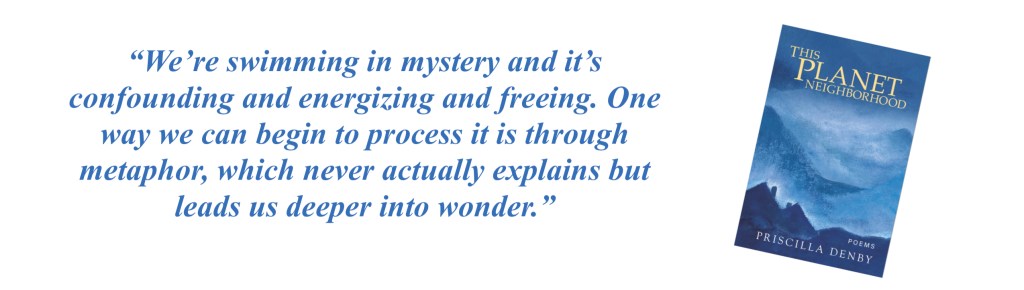
The idea that Earth itself is an organism, growing and changing, and we are all a part of it—not my idea, but one I read about many years ago—has long intrigued me. The myriad mysteries of the universe, ever unfolding, the increasing cohesion of science and religion, or science and non-science: there’s so much we
don’t know, don’t understand, and don’t know we don’t know. We can sort of feel the depth and breadth of the mystery surrounding us. We’re swimming in mystery and it’s confounding and energizing and freeing.
One way we can begin to process it is through metaphor, which never actually explains but leads us deeper into wonder.
You mention metaphor. Metaphors and images seem central to your poetry.
Many elements are intrinsic to poetry—rhythm, music, sometimes rhyme, linguistic play, and, of course, emotional pull, all to varying degrees. So I’m kind of last century. I love
Dylan Thomas, Richard Wilbur, Gerald Stern, e.e. cummings, and, of course, the imagists—William Carlos Williams, Archibald MacLeish, Wallace Stevens, Emily Dickinson. Fabulous modern poets also come to mind—Alessandra
Lynch, Gerald Stern, among others. Certainly, for me, imagery is key. I think MacLeish summed it up when he wrote, “A poem should not mean/ But be.”
What do you (or MacLeish) mean by that?
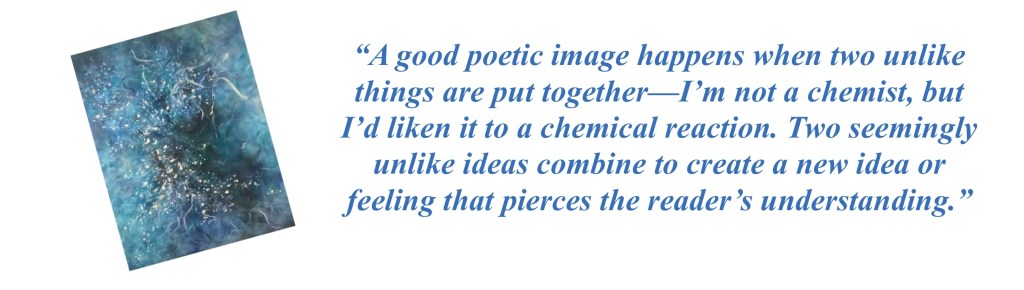
A good poetic image happens when two unlike things are put together—I’m not a chemist, but I’d liken it to a chemical reaction. Two seemingly unlike ideas combine to create a new idea or feeling that pierces the reader’s understanding. Good poetry reverberates, at least for me. Consider “Thirteen Ways of Looking at a Blackbird.” “I don’t know which to prefer, / …The blackbird whistling/ Or just after.” or the twelfth Look, if you will: “It was evening all afternoon./ It was snowing/ And it was going to snow./ The blackbird sat/ In the cedar limbs.” Provocative, elusive— images that communicate understandings I can’t really define or access any other way. The very best images can’t be distilled in prose, nor for that matter, can poems. Trying to reason through a poem may destroy it.
I think that’s what MacLeish means. It’s the reverberation that can’t otherwise be created and which changes, depending on who you are at the time. Most high school students read Williams’ “This is Just to Say” and think it’s a nothingburger, a head-scratcher, whereas more love-experienced folk understand it’s a lover’s note conveying a complex, sensuous relationship. The most powerful images contain music, emotion, linguistic play, all of it. “Now as I was young and easy under the apple boughs, /about the lilting house…” “Time held me green and dying, / Though I sang in my chains like the sea.” Wow. “Rage, rage against the dying of the light.” “The long, perfect loveliness of sow.” I could go on.
Do you often start with an image when you write?
An image may pop into my head. The faraway look of a man describing how a coyote snatched his dog, and the awareness that my responses felt mechanical, as if I were a Mars rover scanning unknown territory, spawned “The Man Whose Dog Was Taken by a Coyote.” Other times I’ll witness an ordinary event and realize it’s a metaphor for something else, something larger. I saw ducks living roadside. After capturing my
reaction, I later saw the scene as metaphor. For the homeless, disenfranchised, victims of drought, a species going extinct? Whatever you glean from it.
Moving forward?
I’m halfway into my next collection which will also focus on our everydayness with larger implications, especially in relation to Time. Studying folklore made me aware of the different ways time is measured and organizes human life. It affects us all, all the time, consciously or unconsciously, without recourse, at least in our culture. Although Time plays a big role in This Planet Neighborhood, it might star in its sequel.
______________________________________
This Planet Neighborhood is available now from Kelsay Books and amazon.com. J.V.Jones’ books are published by Tor Macmillan

All Content Copyright Priscilla Denby 2025
 Priscilla Denby